Shoulder replacement (arthroplasty) replaces damaged bone and cartilage with prosthetic components to relieve pain and restore function, typically due to advanced arthritis or complex fractures.
Is Shoulder Replacement Right for Me?
Shoulder replacement is most appropriate for patients with advanced arthritis who have significant pain and loss of function that is no longer responding to non-surgical care. Good candidates are generally those whose daily life is being meaningfully limited by their shoulder. Certain complex shoulder fractures are also treated with shoulder replacement.
For most patients, surgery becomes the right conversation only after non-surgical options are no longer providing adequate relief. For shoulder arthritis, this typically means a course of anti-inflammatory medications (such as tylenol, ibuprofen or naproxen), activity modification, physical therapy, and corticosteroid injections.
Anatomic vs. Reverse
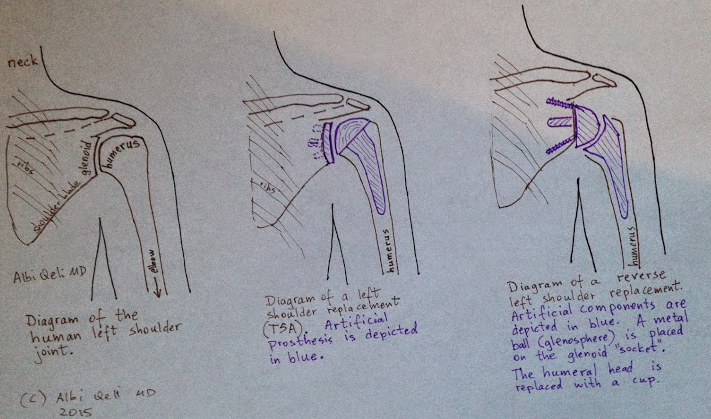
The choice depends on the health of your rotator cuff muscles.
| Feature | Anatomic (Total Shoulder) | Reverse Shoulder Arthroplasty |
|---|---|---|
| Design | Mimics natural anatomy (Ball on humerus, socket on scapula). | Swaps anatomy (Ball on scapula, socket on humerus). |
| Typical candidates | Arthritis with intact rotator cuff | Rotator cuff tear arthropathy, massive cuff tears, or complex fractures. |
| Requirement | Requires a healthy, intact rotator cuff. | Used when the rotator cuff is torn or non-functional. |
| Mechanics | Depends on rotator cuff to maintain center of rotation & help move the shoulder | Depends on the reversed anatomy to maintain center of rotation. Uses the deltoid muscle to lift the arm. |
How Long Does a Shoulder Replacement Last?
Modern shoulder replacements are durable, with survival data comparable to hip and knee replacements. For anatomic total shoulder replacement, studies report implant survival rates of approximately 92–96% at 10 years. For reverse total shoulder replacement, large registry studies show 10-year survival rates in the range of 91–94%, with 15-year survival approaching 85–92%.
Younger age, prior surgery, and certain diagnoses (such as fracture sequelae) are associated with higher revision risk. Most patients can expect their implant to function well for well over a decade, and many considerably longer.
Recovery Timeline
- Weeks 0–6 (Protection): Full time sling use, except for certain exercises. Goal is to minimize pain, while moving the shoulder enough to avoid long term stiffness. Physical therapy starts early with pendulums and active assisted movement. Patients should not drive during the first 6 weeks after surgery.
- Weeks 6–12 (Early Motion): Sling is removed. Active motion begins; you start lifting the arm using your own muscle power.
- Months 3–6 (Strengthening): Focused rehabilitation to regain functional reach and overhead movement.
- Months 6–12 (Full Recovery): Final maturation. Most patients reach maximum improvement by the one-year mark.
Key Risks
- Infection: This is the biggest risk of the surgery. The rate of infection after shoulder replacement is approximately 1%. As a patient, you need to know that treatment often requires additional surgery.
- Instability: Dislocation of the prosthetic joint. Depending on circumstances, treatment of dislocation may require additional surgery.
- Stiffness: Some degree of stiffness is common after shoulder replacement; dedicated physical therapy is the most important factor in achieving the best possible range of motion.
- Component Loosening: Wear over time (may require revision surgery).
- Nerve Injury: Rare, but can affect arm sensation or movement.
- Fracture: Risk of bone breaking during component insertion.